Why Are Dental Claims Getting Denied? 10 Common Reasons & How to Prevent Them
September 16, 2026 · 9 min read
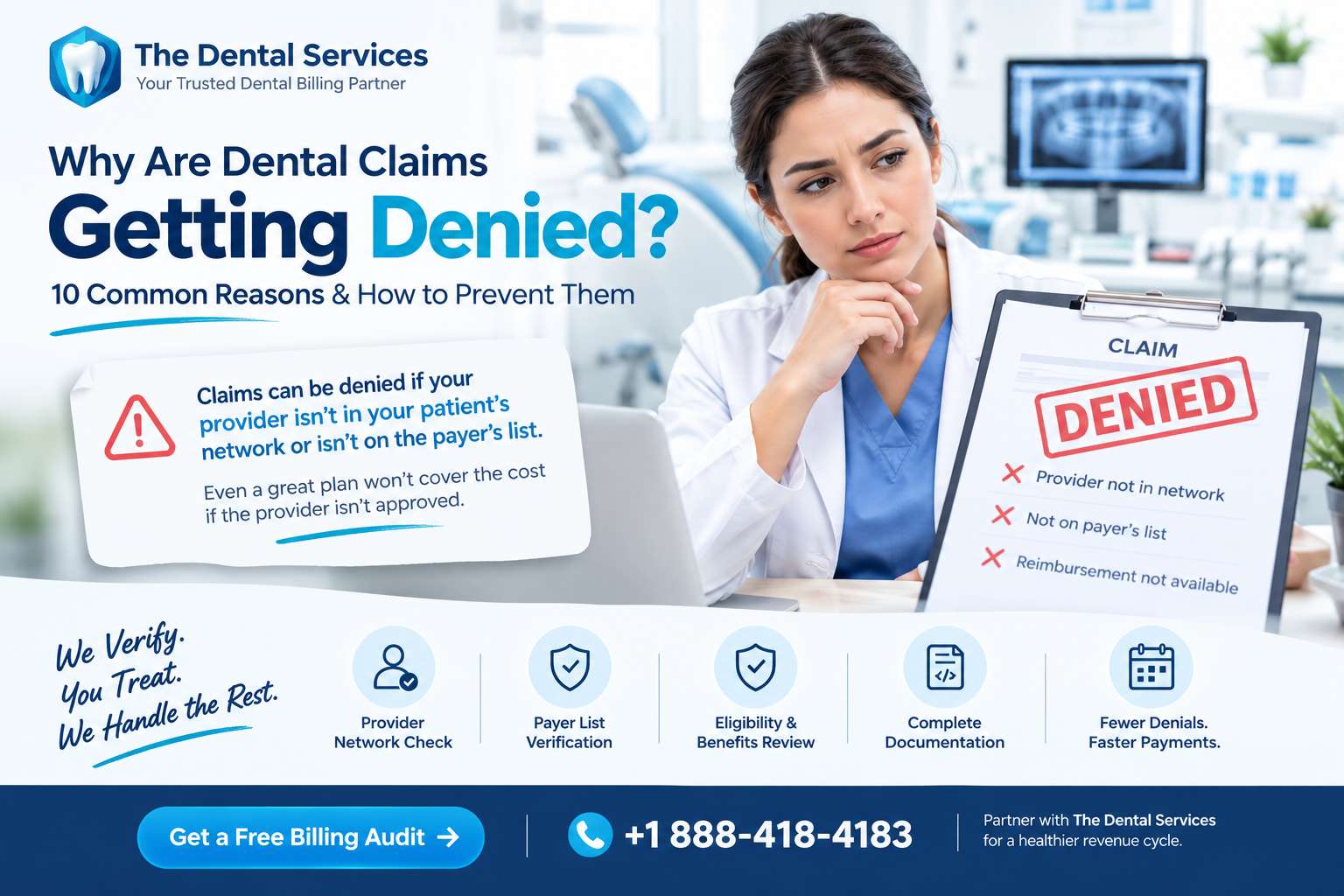
One small billing mistake can cost your dental practice more than just time. It can delay payment, increase A/R, and force your staff to chase money that should have been collected the first time. But here's the frustrating part: many dental claim denials can be traced back to problems that occur before the claim is even submitted. A wrong insurance ID. An eligibility issue. An incorrect CDT code. A missing X-ray. A filing deadline that was overlooked. So, why are dental claims getting denied? Here are 10 common reasons and what your practice can do about them.
❓Why Are Dental Claims Getting Denied?
Dental claims are commonly denied because of incorrect patient or insurance information, inactive eligibility, coding errors, missing documentation, benefit limitations, frequency restrictions, timely filing issues, coordination-of-benefits problems, downcoding or bundling, and payer-specific requirements.
Many preventable denials can be reduced by verifying insurance eligibility before treatment, using accurate CDT coding, submitting complete documentation, checking payer requirements, and monitoring claims after submission.
For U.S. dental practices, a proactive billing workflow is often more effective than waiting until a claim has already been denied.
📋10 Common Reasons Dental Claims Are Denied
🆔1. Incorrect Patient or Insurance Information
A single incorrect digit can send a claim in the wrong direction.
Common errors include:
Wrong member ID
Incorrect date of birth
Misspelled patient name
Wrong group number
Incorrect subscriber information
How to fix it: Verify patient demographics and insurance information before submitting every claim.
🔍2. Insurance Eligibility Wasn't Verified
A patient having an insurance card doesn't necessarily mean their coverage is active. Coverage may have changed since the patient's last visit.
Coverage can change because of:
Employment changes
Plan changes
Policy termination
New benefit periods
Patient eligibility changes
Changes in covered services
Before treatment, your team should verify:
Active coverage
Effective dates
Deductible
Annual maximum
Waiting periods
Frequency limitations
Covered procedures
Why it matters: Proper dental insurance verification can prevent billing problems before treatment begins.
The Dental Services provides dental insurance verification support that includes eligibility, benefits, deductibles, annual maximums, waiting periods, frequency limitations, and covered procedures for U.S. dental practices.
👉 Explore Dental Insurance Verification Services🔢3. The Wrong CDT Code Was Used
The procedure performed and the code submitted need to tell the same story.
Using the wrong CDT code can result in a rejection, denial, downcoding, or unexpected reimbursement.
Before submission, ask: Does the CDT code accurately describe the procedure that was actually performed?
Also make sure the clinical documentation supports the code selected.
📎4. Required Documentation Is Missing
Sometimes the procedure is correct, but the supporting evidence isn't there.
Depending on the procedure and payer, the claim may require:
X-rays
Clinical notes
Periodontal charting
Intraoral photos
Narratives
Other supporting records
If the payer needs documentation and doesn't receive it, payment can be delayed or denied.
Quick fix: Create a checklist for procedures that commonly require attachments and verify them before claim submission.
🚫5. The Procedure Isn't Covered by the Patient's Plan
Here's an important distinction: a procedure being clinically necessary doesn't automatically mean the patient's insurance plan will pay for it.
Dental plans can have:
Exclusions
Waiting periods
Frequency limitations
Age restrictions
Annual maximums
Plan-specific limitations
That's why checking only "Is the patient insured?" isn't enough. Your team needs to understand what the patient's plan actually covers.
🔁6. Frequency Limitations Were Exceeded
Some dental benefits are limited to a specific number of services during a benefit period.
For example, a plan may limit certain preventive procedures to a specific frequency.
If the patient has already reached that limit, the next claim may be denied even when the procedure itself was correctly performed and coded.
What to check: Before treatment or claim submission, review:
Previous dates of service
Benefit history
Remaining benefits
Frequency limitations
Payer-specific rules
“A frequency of denial does not necessarily mean the treatment was clinically unnecessary. It may simply mean that the patient benefit plan does not provide additional coverage for that service during the applicable period.”
⏰7. The Claim Was Filed Too Late
Even a perfectly prepared claim can become unpayable if it misses the payer's timely filing deadline. This becomes especially risky when claims sit in a billing queue or require repeated follow-up.
This can happen when:
Claims remain in a billing queue
Eligibility problems delay submission
Claims are repeatedly corrected
Staff turnover interrupts follow-up
Rejected claims are not corrected quickly
Old A/R is not actively monitored
Protect your revenue:
Submit clean claims quickly
Monitor unpaid claims
Track payer-specific filing deadlines
Keep proof of submission when available
Escalate unresolved claims early
“Timely filing isn't just an administrative detail. It's a revenue protection strategy.”
📉8. The Claim Was Downcoded or Bundled
Sometimes the payer processes a claim but doesn't reimburse it exactly as submitted.
The payer may apply:
Downcoding
Bundling
Least expensive alternative treatment provisions
Plan-specific processing rules
What is downcoding? Downcoding occurs when a dental plan uses a different procedure code to determine the benefit amount than the code submitted by the dentist. The ADA provides examples of downcoding and recommends reviewing payer policies and appealing an adverse decision when appropriate.
This is why your billing team should not simply look at the payment amount.
Read the EOB. The explanation and remark codes can tell you whether the claim should be corrected, appealed, or handled as patient responsibility.
🧮9. Coordination of Benefits Is Incorrect
When a patient has multiple insurance plans, determining the correct primary and secondary payer is essential.
Problems occur when:
The wrong insurance is billed first
Secondary coverage is outdated
The primary EOB is missing
Subscriber information doesn't match
The patient's insurance situation has changed
Fix: Keep coordination-of-benefits information updated and verify it when necessary.
📄10. Pre-Authorization Was Mistaken for Guaranteed Payment
Pre-authorization can help estimate how a plan may handle treatment. But it doesn't always mean the insurance company will definitely pay this claim.
Eligibility, benefits, maximums, limitations, and other plan conditions can affect the final claim decision.
Make sure your team and patients understand the difference between pre-authorization and guaranteed payment.
⚖️Claim Rejected vs. Claim Denied: What's the Difference?
This distinction is important because a rejected dental claim and a denied dental claim are not necessarily the same problem.
↩️Dental Claim Rejection
A rejection generally means that a claim or claim information did not pass an initial processing or submission check. The claim may need to be corrected and resubmitted.
Examples can include:
Missing information
Invalid patient information
Incorrect payer information
Invalid claim data
Coding or submission errors
Missing required information
✋Dental Claim Denial
A denial generally occurs after the claim has been accepted for processing and adjudicated, but the payer determines that payment should not be made or should be reduced.
Possible reasons include:
Benefit limitations
Eligibility issues
Coding problems
Missing documentation
Frequency limitations
Timely filing
Coordination-of-benefits issues
Payer processing policies
✅How Can You Reduce Dental Claim Denials?
The best time to fight a denial is before the claim is submitted. A simple pre-submission workflow can catch many preventable problems.
Patient
Is the demographic and insurance information correct?
Eligibility
Is the coverage active and are benefits available?
Coding
Does the CDT code match the procedure performed?
Documentation
Are required X-rays, narratives, and clinical records attached?
Submission
Is the claim complete and within the payer's filing deadline?
Follow-up
If the claim isn't paid, has someone identified the exact reason?
This turns claim management from a reactive process into a proactive dental revenue cycle strategy.
🛠️What Should You Do When a Dental Claim Is Denied?
Don't immediately resubmit the same claim. First, identify why it was denied. Then choose the appropriate action:
Incorrect information → Correct and resubmit
Missing documentation → Add documentation and resubmit
Coding issue → Review and correct the code
Benefit limitation → Review patient responsibility
Payer error → Contact payer or appeal
Timely filing issue → Review proof of timely submission
The goal isn't simply to submit more claims. The goal is to submit cleaner claims and recover the revenue that belongs to your practice.
Review the EOB
Identify the denial reason
Check the payer's remark/adjustment codes
Determine whether the claim should be corrected or appealed
Gather supporting documentation
Correct the claim
Resubmit or appeal
Track the claim
Record the root cause
Prevent the same denial from happening again
🩺How Dental Billing & RCM Support Can Help
A structured dental billing and revenue cycle management process can help practices manage the financial workflow from insurance verification through claim submission, payment posting, denial management and A/R follow-up.
The Dental Services provides outsourced dental billing and RCM support for U.S. dental practices, including:
Insurance verification
Eligibility and benefits verification
Dental insurance billing
Clean claim submission
CDT coding support
Denial management
Appeals handling
Payment posting
Insurance A/R follow-up
Secondary and tertiary claim coordination
Revenue cycle reporting
The Dental Services states that its billing team works with U.S. dental practices and supports practices ranging from solo offices to multi-location groups and DSOs.
The company also describes its denial-management process as identifying the root cause, correcting and resubmitting claims, handling appeals, and analyzing recurring denial patterns to help prevent future denials.
👉 Explore Dental Billing & RCM Services