
Dental Billing: A Simple Guide From Patient Check-In to Payment
August 20, 2026 · 8 min read
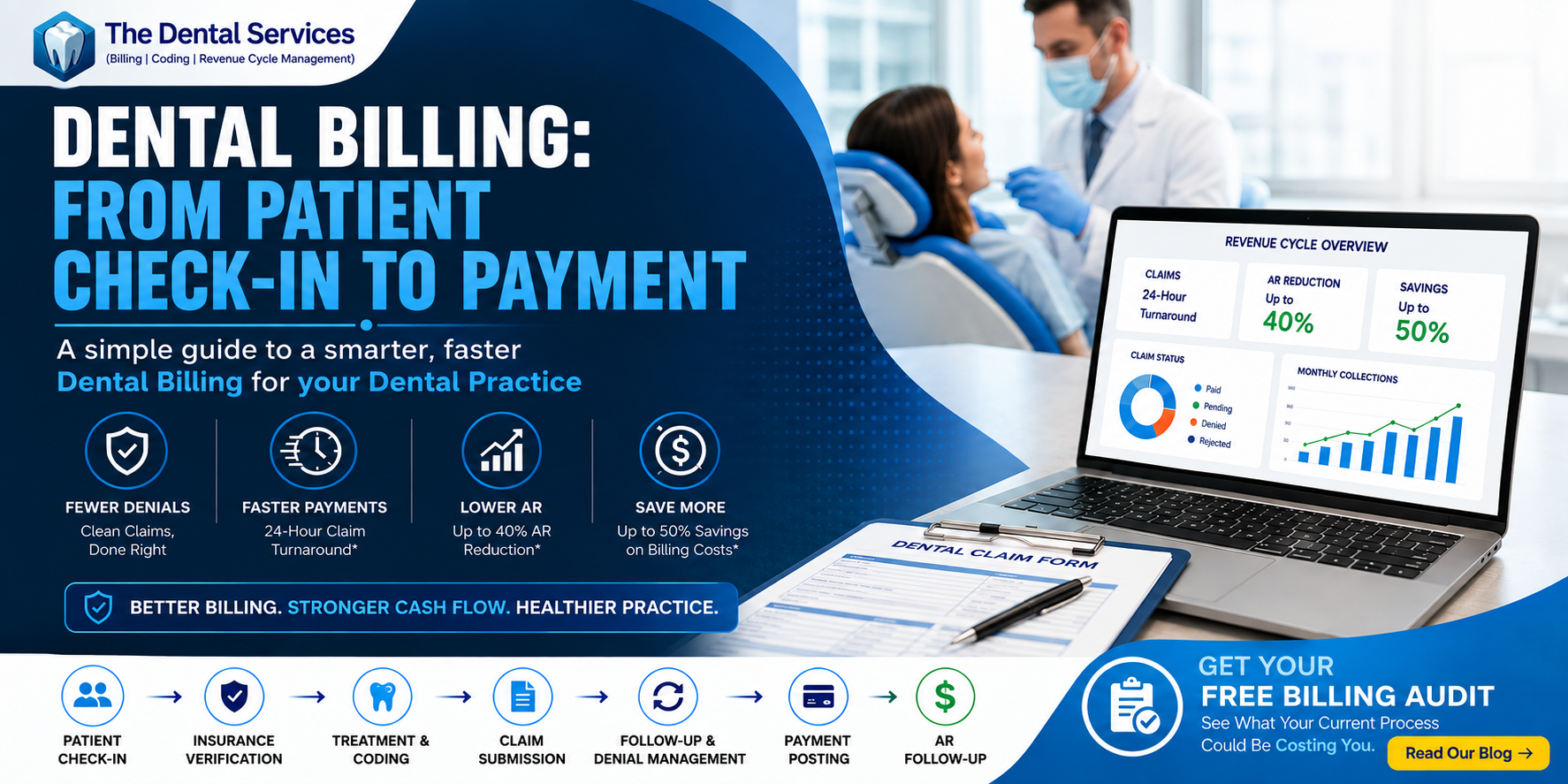
Your practice is treating patients every day. But are you collecting everything you've earned?
A patient checks in. Treatment is completed. The claim is submitted. But that's not where the money story ends.
A claim can be delayed. A payment can be missed. A denial can sit unresolved. AR can quietly grow.
And over time, these small gaps can turn into lost revenue and unnecessary costs.
This guide breaks down how the dental billing process works in a U.S. dental practice, what commonly causes payment delays, when dental billing services may make sense for your practice, and how the right billing strategy can help your practice save money and collect faster.
🧾What Is Dental Billing?
Dental billing is the process of turning completed dental treatment into collected revenue.
It covers everything from:
Insurance verification
Claim submission
Claim follow-up
Denial management
Payment posting
Patient billing
AR follow-up
In simple terms: Treatment → Claim → Insurance → Payment → Collection
The goal isn't simply to submit claims. The goal is to get them paid accurately and on time.
⚙️How Does the Dental Billing Process Work?
🚪1. Patient Check-In & Insurance Verification
Before treatment begins, your practice needs accurate patient and insurance information.
Your team may verify:
Eligibility
Benefits
Deductibles
Waiting periods
Frequency limitations
Patient responsibility
Why does this matter?
Because an incorrect or outdated insurance detail can create a claim problem later.
One missed detail today can mean a delayed payment tomorrow.
The Dental Services verifies coverage, remaining benefits, frequency limitations, and waiting periods before treatment.
👉 Explore Dental Insurance Verification Services📝2. Treatment Documentation & Coding
Once treatment is completed, the documentation needs to support the service provided.
The appropriate CDT codes and claim information then need to be prepared accurately.
Problems such as incorrect coding, missing information, or documentation issues can contribute to claim delays or denials.
“Clean billing starts before the claim is submitted.”
The Dental Services says its billing specialists use current CDT coding and payer-specific claim scrubbing, with a reported 98%+ first-submission clean claim rate.
98%+
First-submission clean claim rate
❌Why Are Dental Claims Denied?
A denied claim isn't necessarily lost revenue.
But it is uncollected revenue that needs action.
Common issues can include:
Eligibility problems
Coding issues
Missing information
Documentation requirements
Benefit limitations
Payer-specific requirements
The important part is what happens next.
Review → Correct → Resubmit or Appeal → Follow Up
The Dental Services's denial management process focuses on identifying the root cause, correcting the issue, and pursuing resubmission or appeals within payer timelines.
Every unresolved denial is another opportunity for revenue to remain stuck.
📬What Happens After a Dental Claim Is Submitted?
Submitting a claim isn't the finish line.
The claim still needs to be tracked until it is:
Paid → Denied → Rejected → Corrected → Resubmitted → Resolved
Without consistent follow-up, outstanding claims can continue aging.
And aging claims can affect cash flow.
The Dental Services reports an average 24-hour claim turnaround and active follow-up on outstanding balances.
24 hrs
Average claim turnaround
Faster claim movement can mean faster access to the money your practice has already earned.
💵What Is Payment Posting in Dental Billing?
When an insurance payment arrives, it needs to be posted accurately to the correct patient account.
That means knowing:
What insurance paid
What was adjusted
What the patient owes
What remains outstanding
Accurate payment posting helps keep your financial records and patient balances clear.
The Dental Services handles payment posting for EFTs, checks, and virtual card payments with line-item accuracy.
Because collecting revenue is only half the job. You also need to know where that money went.
📈What Is Dental AR Follow-Up?
Accounts receivable is money that is still owed to your practice.
That can include unpaid insurance claims and outstanding patient balances.
The longer those balances remain unresolved, the longer your practice waits to collect.
That's why consistent AR follow-up matters.
The Dental Services reports an average 40% AR balance reduction and follows outstanding balances at 30-, 60-, and 90-day intervals.
40%
Average AR balance reduction
Less aging AR can mean healthier cash flow and fewer dollars sitting on your books.
💸What Can Poor Dental Billing Cost Your Practice?
This is where billing becomes a business issue.
A practice can lose money through:
Preventable claim denials
Delayed reimbursements
Unworked AR
Incorrect payment posting
Repeated claim corrections
Unnecessary in-house billing costs
And there's another number worth looking at:
How much are you spending every month just to keep billing running?
The Dental Services states that the average solo practice can spend $4,000-$8,000 per month on in-house billing operations before considering revenue tied up in unworked denied claims.
That changes the conversation.
“Instead of asking: "What does dental billing cost?" Ask: "What is my current billing process costing me?"”
🤝Can Outsourced Dental Billing Save Your Practice Money?
It can, depending on your practice and current billing costs.
The value isn't simply moving billing somewhere else.
It's about replacing multiple internal costs with a specialized dental billing model designed around collections, efficiency, and measurable results.
The Dental Services promotes 50% guaranteed savings, performance-based pricing, and no contracts or hidden fees.
50%
Guaranteed savings vs. in-house billing costs
That can help practices reduce the cost of maintaining billing internally while also addressing revenue that may be stuck in denials or aging AR.
The potential savings can come from:
Lower billing overhead
Fewer preventable denials
Faster claim processing
More consistent AR follow-up
Reduced billing-related costs
Better collection efficiency
The real opportunity isn't just spending less.
“It's keeping more of the revenue your practice has already earned.”
🗂️What Does a Dental Billing Company Actually Handle?
A specialized dental billing company can manage the revenue cycle from verification through collection.
The Dental Services provides:
Dental insurance verification
Clean claim submission
Denial management
Claim resubmissions and appeals
Payment posting
Patient billing
AR follow-up
Revenue cycle management
The company works with solo practices, multi-location groups, and DSO-affiliated offices across the U.S.
And because dental billing is its specialty, the team focuses specifically on dental payer rules, CDT coding, claims, and revenue-cycle workflows.
👉 Explore Dental Revenue Cycle Management Services❓Is Outsourcing Dental Billing Worth It?
The answer depends on your numbers.
If your practice has:
Growing AR
Frequent denials
Slow claim processing
High in-house billing costs
Unresolved insurance claims
Revenue sitting in aging accounts
then it's worth finding out what your current process is actually costing.
You don't have to guess.
Start with the numbers.
🔍Find Out How Much Your Billing Could Be Costing You
Before changing your billing process, find out where the money is going.
The Dental Services offers a Free Billing Audit that reviews your current billing workflow, aging report, and claim history to identify potential recoverable revenue.
You can discover:
Where claims are getting stuck
Which denials are recurring
How much AR is aging
Where revenue may be delayed
Where billing costs can potentially be reduced
And the best part?
You don't have to commit to outsourcing just to find out.
The audit is presented by The Dental Services as free and no-obligation.
💰Your Practice Already Earned the Revenue. Are You Collecting It?
Every completed procedure creates an opportunity to collect revenue.
But between treatment and payment, there are multiple places where money can get delayed.
Denied claim. Aging AR. Delayed follow-up. Unnecessary billing cost.
These don't look huge individually.
But together, they can make a real difference to your bottom line.
See where revenue is getting stuck. Identify potential savings. And find out what your practice could be leaving on the table.
Don't guess what your billing is costing you. Find out.
Keep Reading
 Practice Brokerage
January 12, 2026 · 7 min read
The Ultimate Guide to Buying or Selling a Dental Practice in the USA
Buying or selling a dental practice is a life-changing decision. This guide walks you through valuations, legal, financial, and staffing considerations to ensure a smooth and successful transition.
Read More →